
NATARAJA PAATHAI
NATARAJA ICON: Artistic Apex OF Universal Resonance
Through this trip, we unravel the esoteric wisdom, sacred geometry, and philosophical secrets encoded in the Ananda Tandava (the divine dance of bliss), bridging ancient traditions with the fundamental forces that govern the universe.
In the vast landscape of sacred art, few images capture the complexity of the universe and human existence as masterfully as the Nataraja Icon—the cosmic form of the Hindu deity Shiva as the “King of Dance”. Emerging from the philosophical traditions of South India and perfected during the Chola Dynasty, the bronze image of Nataraja is far more than a masterpiece of ancient metallurgy; it is a profound visual metaphor for the dynamic forces of nature, space, and time.
Performing his divine dance, the Ananda Tandava (“Dance of Bliss”), Nataraja embodies the endless loop of cosmic manifestation and dissolution. Through a harmony of paradoxes, the iconography of Nataraja translates complex metaphysical truths into a form that continues to captivate art historians, philosophers, and modern scientists alike.
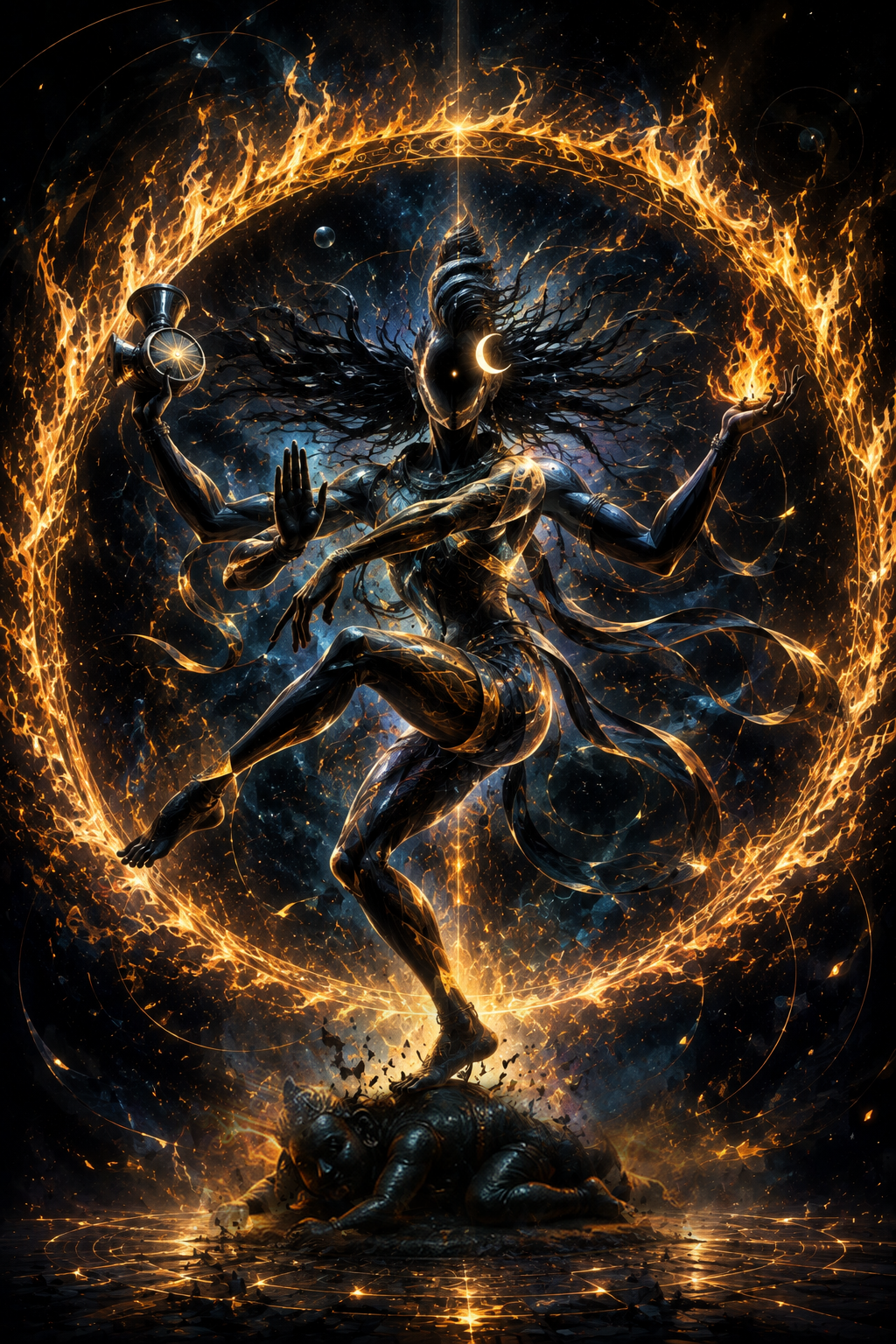
The Iconography, Philosophy, and Universal Echoes of Lord Nataraja
At the heart of the Nataraja imagery lies the concept of perpetual motion as the underlying truth of reality. In Western traditions, creation is often viewed as a linear sequence with a definitive beginning and end. In contrast, Indian cosmology perceives time as cyclical, driven by the rhythmic motion of the divine consciousness. Nataraja’s dance encapsulates five fundamental cosmic activities, known as the
Panchakriya:
Srishti (Creation): The Upper Right Hand (Damaru)
The initial pulse of creation that gives birth to matter and form. Nataraja holds a small, hourglass-shaped drum. As it beats, it releases the primal sound (Nada), the fundamental vibration that stirs dormant matter into life and initiates the creation of time and space.
Sthiti (Preservation): The Lower Right Hand (Abhaya Mudra) The Lower Right Hand (Abhaya Mudra)
The sustained order that nurtures and protects life in the universe. Raised in the universal gesture of protection and reassurance, this hand promises safety from fear, reminding the seeker that despite the turmoil of a changing universe, divine order prevails.
Samhara (Destruction): The Upper Left Hand (Agni)
The necessary dissolution of worn-out forms to pave the way for renewal. In stark balance to the drum, the opposing hand holds a tongue of fire. While the drum represents creation, fire represents destruction. Held in balance, they signify that creation and dissolution are inextricably linked.
Tirobhava (Concealment): The Feet and Apasmara
The veil of illusion (Maya) that hides divine reality, allowing souls to experience the material world. Nataraja’s right foot rests squarely upon the back of Apasmara Purusha—a dwarf demon representing ignorance, forgetfulness, and the unbridled ego. By stepping on Apasmara rather than slaying him outright, Nataraja signifies that ignorance cannot be destroyed entirely, but must be continuously subdued through knowledge and self-awareness.
Anugraha (Grace): The Lower Left Hand (Gajahasta)
The ultimate act of divine revelation that liberates the soul from the cycle of rebirth (Samsara). Crossing the chest like an elephant’s trunk, this hand points downward toward the raised left foot, guiding the observer’s focus toward the source of spiritual salvation. Conversely, his lifted left foot floats effortlessly in the air, representing ultimate liberation (Moksha) and grace.
Encasing the dancer is a circular halo of flames, representing the physical universe bound by time, space, and the endless cycles of cause and effect.
Nataraja’s hair flies outward in wild strands, capturing the sheer intensity and kinetic power of the dance. Interspersed within his matted locks (EncasingJata) are Goddess Ganga—symbolizing the cooling, life-giving waters of spiritual purity—and the crescent moon, signifying the measurement of time and the tides of mind and emotion.
A Journey Through Cosmic Rhythm & Sacred Art
The Nataraja Nadai is a conceptual trip designed at the intersection of art history, culture, and philosophy, from raw stone reliefs and vivid wall frescoes to the golden zenith of metal bronze casting. This curated itinerary examines the iconographic and material evolution of the Nataraja Icon across a chronological continuum, charting how artisans progressively translated abstract cosmological concepts into tangible physical forms. Tracing a chronological arc through three distinct artistic mediums—stone, pigment, and metal—it is an itinerary designed for art lovers, historians, and spiritual seekers, tracing how an abstract theological vision evolved from crude stone reliefs into vivid temple frescoes, ultimately reaching its absolute zenith in the bronzes of Medieval South India. This itinerary offers a profound look into the places where the most important Nataraja icons were ever created.
1. Seeyamangalam, 2. Tirumalai Samanar Hill, 3. Kancheepuram, 4. Panamalai, 5. Rockfort Upper Caves, 6. Thiruparankundram, 7. Sevalpatti
8. Thirumalapuram, 9. Chithira Sabai, 10. KariSulnthaMangalam, 11. Sepparai, 12. Kattarimangalam, 13. Karuvelankulam, 14. Sucheenthram, 15. Vizhinjam
16. Uthirakosamangai, 17. Kunnakudi, 18. Thirumayam, 19. Sithannavasal, 20. Ootathur, 21. Chidambaram
To follow this path is to witness how human culture transformed a singular divine vision into one of the world’s most enduring gifts to global art. The trip “Nataraja Paathai” is ultimately more than an itinerary of places and artifacts. It is an exploration of human imagination at its absolute peak.