
Order, Rhythm, and the Cosmic Sabha: An Educational Trip
SABHAI VAZHI
The Five Sabha trip offers a masterclass in civic heritage. By traversing the historic trade routes that bridged the Cauvery, Vaigai, and Thamirabarani river basins, this itinerary uncovers a civilization that integrated its spiritual life with democratic ideals. It proves that the sabhas (assembly halls) were primarily built as vibrant public forums—spaces where citizens gathered to govern their communities, debate public affairs, and evaluate the finest expressions of art and literature.
The history of the Sabha in the Indian subcontinent represents not merely the evolution of an administrative institution but the transformation of a civilizational idea. Over more than three millennia, public assembly spaces evolved from the archaeological civic structures of the Indus Valley to Ancient India’s deliberative councils, Sangam village forums, Chola local self-governing bodies, and, finally, the sacred dance halls of Shiva. They collectively reflect a persistent Indian conception of order as something established through assembly, deliberation, and shared participation. In the Five Sabhas of Shaivism, this tradition reaches its highest symbolic expression: the assembly is no longer merely a place where humans negotiate social order, but the cosmic stage upon which Shiva’s dance sustains the order of the universe.
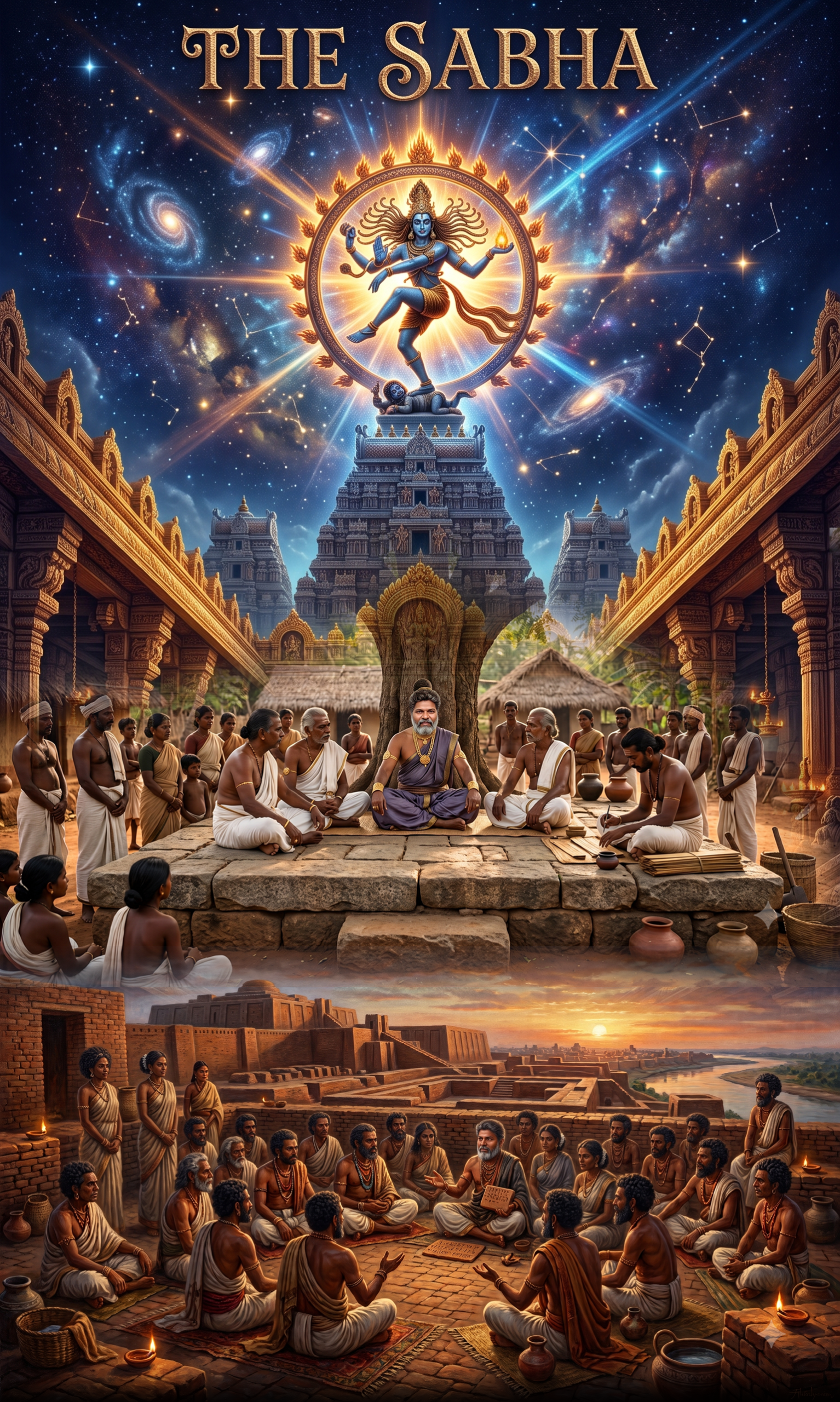
THREE MILLENIA OF CIVILIZATIONAL & COSMIC EVOLUTION
The concept of the “Sabha”—a deliberative assembly, council of elders, or public forum—is one of the most
enduring political, social, and cultural institutions in the Indian subcontinent. Across different historical epochs and geographical regions, the Sabha served as a hub for consensus-building, governance, judicial resolution, trade regulation, and cultural expression.
In the Indus Valley Civilization, a citadel has been excavated by archaeologists in the mounds of Mohenjo-daro. This Citadel is a massive square building (approximately 27 × 27 meters) featuring 20 brick pillars arranged in four rows. This structure is widely interpreted as a civic council chamber, a guild hall, or an administrative meeting place rather than a residence or temple.
In Ancient India, the administration was held by Sabha and samiti. The Sabha (Exclusive Council): A smaller, select body composed of elders, brahmans, nobles (rajanya), and prominent clan members (Sabhāsad). The Samiti (General Assembly): A larger, folk assembly representing the broader population (vis).
In the ancient Tamil country (Tamilakam), assembly culture operated simultaneously at the royal level and the grassroots village level. In villages, public business was conducted at open-air sites called Podiyil or Manram, often located under a sacred tree (such as a Banyan, Neem, or Jackfruit tree) or near a village shrine. As early medieval dynasties (Pallavas, Pandyas, and Cholas) developed local administration systems rooted in Sangam traditions, village assemblies formalized into three structures: Ur: The general assembly of non-Brahmadeya (landholding) villages. Nagaram: The assembly of merchants, artisans, and trade guilds in commercial towns. Sabhai (or Mahasabha): The exclusive assembly of Brahmadeya (tax-free land granted to scholars/Brahmins) villages, operating with detailed administrative autonomy.
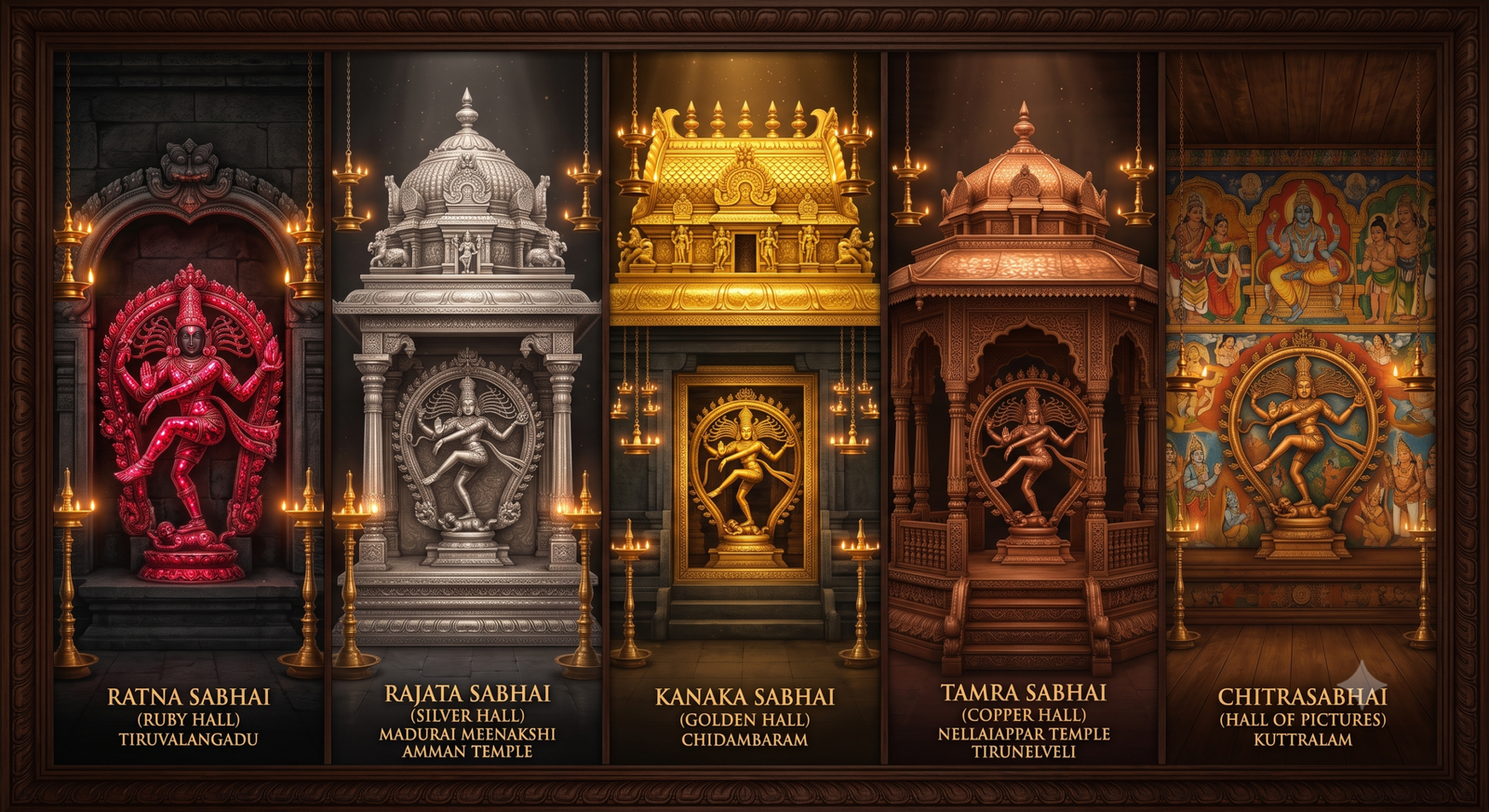
Across these three traditions, the Sabha concept demonstrates that governance in ancient India was not purely autocratic or unilateral. They used local assemblies, council debates, consensus-building, and public forums to manage civic, judicial, and cultural affairs. A subtle structural connection lies in how ancient Indian assemblies organized their administration through quinary (five-fold) structures and material associations, which directly parallel the Five Sabhas: Ruby/Gems (Ratna), Gold (Kanaka), Silver (Velli), Copper (Tamra), and Paint/Frescoes (Chitra).
Kanaka Sabha – Chidambaram (Golden Hall)
The Kanaka Sabha occupies the central position among the Five Sabhas and is regarded as the spiritual heart of the Nataraja tradition. Here Shiva performs the Ananda Tandava, the Dance of Bliss. Gold symbolizes: illumination, incorruptibility, perfection, divine consciousness. The golden roof reflects the brilliance of pure awareness, while the famous Chidambara Rahasya (“Secret of Chidambaram”) teaches that the ultimate reality is the formless, all-pervading consciousness beyond material representation. The Kanaka Sabha therefore represents the highest realization of spiritual truth, where the visible dance and the invisible Absolute coexist.
Rajata Sabha – Madurai (Silver Hall)
The Silver Hall inside the Meenakshi–Sundareswarar Temple commemorates Shiva’s dance before Queen Meenakshi and King Sundareswarar. Silver traditionally symbolizes: purity, calmness, reflection, receptivity. Unlike the transcendental atmosphere of Chidambaram, Madurai emphasizes Shiva’s intimate relationship with the human world. Here the cosmic dancer also becomes the divine king, husband, and protector of society. The Rajata Sabha therefore represents the accessibility of divine grace within everyday life.
Ratna Sabha – Thiruvalangadu (Ruby Hall)
The Ratna Sabha is associated with the celebrated dance contest between Shiva and Goddess Kali.
When Kali challenged Shiva to a dance competition, Shiva performed the Urdhva Tandava, raising his foot above his head. Kali, constrained by modesty according to the traditional narrative, did not replicate the movement, and Shiva was declared victorious. Ruby symbolizes: brilliance, vitality, spiritual fire, and awakened consciousness. Rather than signifying domination, the narrative is generally interpreted within Shaiva theology as symbolizing the transcendence of ego and the victory of cosmic equilibrium over uncontrolled energy.
Tamra Sabha – Tirunelveli (Copper Hall)
The Copper Hall at Tirunelveli reflects the dynamic aspect of Shiva’s dance. Copper has long been associated with transformation, conductivity, vitality, and continuity. Unlike gold or silver, copper develops a natural patina over time, making it an apt metaphor for continual change within enduring existence. The Tamra Sabha therefore represents the ceaseless transformation through which the universe continually renews itself while preserving its underlying order.
Chitra Sabha – Courtallam (Painted Hall)
The Chitra Sabha is unique among the Five Sabhas because it derives its identity from painting rather than metal. Its walls contain elaborate murals depicting episodes from Shaiva mythology and the life of Nataraja.
Situated amidst the forests and waterfalls of the Western Ghats, Courtallam integrates architecture, landscape, and sacred art into a single experience. The Painted Hall symbolizes: imagination, artistic creation, multiplicity, the universe as divine expression. Unlike the metallic halls, Chitra Sabha reminds devotees that creation itself is an ever-changing cosmic painting continuously produced through Shiva’s dance.
In earlier Indian history, the Sabha was a place where human communities gathered to deliberate, administer justice, regulate society, and preserve order. In the Shaiva imagination, this familiar institution was elevated into a metaphysical symbol. The divine Sabha became the stage where the cosmic order itself is sustained through Shiva’s eternal dance. The Five Sabhas are best understood as an integrated philosophical and cultural system rather than merely five independent temples. In this vision, the universe itself is an eternal assembly, and Shiva, as Nataraja, is both its presiding presence and its perpetual dancer, sustaining existence through rhythm, balance, and grace.